
.svg)
An Uber for Education
Modern secondary education emerged during an era when nation-states required schools to generate literacy, social order, and a capable workforce for industrial and bureaucratic systems. Standardization, common curricula, and structured routines were practical responses to the civic and economic demands of their time.
A key moment was the 1893 Committee of Ten, led by Charles W. Eliot, which called for uniformity in secondary education. Their recommendations reflected the need for comparability and efficient mass education, essential for expanding economies and societies seeking disciplined citizens. For much of the twentieth century, this system suited many advanced economies. Mass schooling drove industrial growth and social mobility, even as it often perpetuated inequality. The promise was clear: work hard in school, earn credentials, and expect economic stability.
However, the pace of economic change soon outstripped that of schools. As advanced economies moved from industrial production toward knowledge work, services, software, automation, data systems, entrepreneurship, and innovation-led competition, the value of human capability began to shift. The premium moved away from routine repetition and toward a different cluster of capacities: problem framing, communication, adaptability, initiative, collaboration, ethical judgment, digital fluency, and the ability to continue learning in changing environments.
Many schools failed to adapt, instead focusing on what is easiest to measure. In the US, reports such as A Nation at Risk (1983) led to greater standards, testing, and accountability. Policies like No Child Left Behind and Race to the Top emphasized test results. While these reforms aimed to improve and promote equity, they often narrowed the definition of success to testable outcomes.
This is where Ted Dintersmith’s critique becomes especially important. His central argument is that a major problem is not just stagnation in schools, but a fundamental misalignment. Schools continue to refine a model aimed at standardization, even as the economy has shifted to reward skills such as agency, adaptability, creativity, and judgment. Dintersmith is not just saying schools are falling short—he asserts they are optimized for outdated goals and have been pushed even further into a mindset focused on compliance, performance, and rigid student sorting.
The urgency of this misalignment becomes clear in today’s market. The World Economic Forum’s Future of Jobs Report 2025 projects enormous labor-market churn by 2030: 170 million jobs created and 92 million displaced, for a net increase of 78 million jobs globally. It also identifies analytical thinking, resilience, flexibility, leadership, creative thinking, motivation, self-awareness, and technological literacy among the capabilities rising fastest in importance. This is not a marginal update to the labor market. It is a signal that economies are reorganizing around skills and combinations of judgment that do not fit neatly inside the old architecture of drill, recall, and narrow academic ranking.
The economic impact is significant. The OECD’s 2023 Adult Skills Survey shows that adult skills drive productivity, and skill gaps explain a large share of productivity differences between countries. Productivity is better where skills match jobs. When education produces mismatched skills, it leads to slower productivity, weaker innovation, and wasted talent.
The global dimension makes the case even more urgent. UNESCO reports that hundreds of millions of young people worldwide remain outside the labor force, education, or training. That figure is not merely a social policy concern. It reflects a structural failure to build clearer bridges between education, identity, employability, and meaningful participation in modern economies. At the same time, systems around the world continue to face foundational learning problems, which means the challenge is not to abandon literacy and numeracy, but to stop treating them as the ceiling of educational ambition. The world needs stronger foundations, but it also needs stronger transitions from school into adult contribution.
Dintersmith’s criticism of reading and math resonates with families and teachers. He does not oppose rigor, but questions misplaced rigor. Many schools still drill students on skills machines can do, ignoring skills like estimation, argument, interpretation, design, decision-making, optimization, communication, and solving real problems. When reading means test prep and math is cut off from real life, students disengage. This is a natural result of prioritizing testability over real value.
Ironically, international assessments are moving beyond outdated measures. OECD’s PISA 2022 now gauges creative thinking—the ability to generate and improve ideas in varied contexts. Even organizations focused on global comparison see that narrow proficiency is not enough. Creativity has real economic value.

This broader perspective also helps explain why the debate should not be framed as a college-versus-career choice. That binary belongs to an older era. In modern economies, both academic and vocational trajectories require adaptability, judgment, digital fluency, communication, and a commitment to lifelong learning. The most effective systems are likely to be those that stop treating practical capability as inferior to academic prestige and instead create multiple respected ways for young people to build competence, identity, and contribution. The issue is not whether every student should pursue a university. The issue is whether every student should leave secondary education with evidence that they can do something meaningful, create something real, solve a problem, and continue growing.
The essential question is: What specific changes does secondary education need in order to address its misalignment with current economic and societal needs?
First, protect core learning, but do not let testing take over the meaning of school. Literacy and numeracy are crucial, but only a starting point. Secondary education should also teach students to interpret, communicate, create, collaborate, and apply their knowledge in new settings.
Second, shift graduation requirements toward portfolios, capstones, exhibitions, and long-term interdisciplinary projects. If students spend years in school but only have scores and transcripts, we miss their real growth. Capstones would connect standards with real work, persistence, revision, and pride.
Third, build better pathways from school to real work, without reducing education to job training. Young people need to see real work, but also need mentorship, ethics, civic purpose, and self-understanding. Schools must provide career exploration, applied projects, internships, and visibility into the real economy.
Fourth, secondary education needs a serious settlement with AI. It is increasingly difficult to justify a schooling model that leaves graduates unprepared to work intelligently with systems that are already changing knowledge work, communication, design, analysis, and entrepreneurship. This does not mean surrendering thinking to machines. It means teaching students how to use AI critically: how to prompt, verify, challenge, refine, disclose, and integrate AI into authentic human work. In the same way that earlier generations needed print literacy and later digital literacy, this generation needs AI literacy as a baseline for real participation in economic life.
Fifth, and perhaps most importantly, no redesign of education will succeed unless it restores teachers' economic, moral, and professional status. The next era of schooling will require not weaker teachers, but more capable, entrepreneurial, and better-supported ones. If schools are expected to cultivate creativity, judgment, resilience, AI literacy, global awareness, values, and personalized pathways, then teachers cannot remain trapped inside an outdated compensation model that treats them as low-upside employees while asking them to carry increasingly complex social responsibilities.
This is a global problem. UNESCO estimates that the world will need 44 million additional primary and secondary teachers by 2030 to meet universal education goals. This shortage is not simply a matter of recruitment. It reflects a deeper crisis of professional attractiveness, compensation, workload, training, status, and retention. When the profession does not offer dignity, economic security, autonomy, and a sustainable life structure, talented young people hesitate to enter it, and experienced teachers leave it. In that sense, the teacher shortage is not only an education problem. It is a labor-market design problem.

OECD data points in the same direction. Across OECD countries, teachers’ actual salaries at the primary and secondary levels are generally lower than those of other tertiary-educated workers. This matters because teaching increasingly requires graduate-level judgment, emotional intelligence, data literacy, digital fluency, and the ability to manage diverse student needs. Yet the compensation structure often fails to reflect that level of professional complexity.
The consequences are visible. When salaries do not support a normal life, teachers are pushed into second jobs, private tutoring, after-school lessons, weekend work, and holiday work. Private tutoring becomes not only an educational service but a survival mechanism. That may help individual teachers close a financial gap, but it creates a deeper system problem. It fragments the teacher’s time, energy, and emotional bandwidth. It curtails lesson preparation, weakens rest, increases burnout, and turns excellent educators into overextended workers.
Over time, low teacher pay can also become a societal and political problem. When formal compensation is insufficient for decades, a shadow education economy begins to grow around the school system. Teachers tutor after school. Tutoring centers expand. Families begin to believe that the “real” preparation happens outside the school day. Students attend school in the morning and then attend a second education system in the afternoon or evening. The state underpays the teacher, and the family pays the difference after school.
At first, this may look like a practical survival arrangement. Teachers earn extra income. Families get more support. Students receive additional instruction. But over time, the arrangement becomes structurally dangerous. It creates a large interest group whose income depends on the continuation of the very problems reform is supposed to solve. If the regular school becomes stronger, more personalized, more exam-effective, and more trusted by parents, then the private tutoring market may shrink. That means some teachers, tutoring centers, exam-prep providers, and related businesses can, by default, become resistant to reforms that would make the formal school day more effective.
This does not mean teachers are the problem. It means the system has placed teachers in a conflict of interest. A teacher may care deeply about students while also depending financially on extra lessons because the formal system is not enough. That is not a moral failure on the teacher's part. It is a design failure of the education system.
Greece offers a clear example. The country has a long-standing culture of frontistiria, private tutoring centers that support students preparing for high-stakes examinations and university entrance. For many families, participation in this parallel system is treated almost as a necessity rather than a luxury. The formal school remains important, but the decisive preparation often happens after school. This creates a dual system: school during the day, private tutoring in the afternoon and evening. Families pay twice, students work longer hours, and teachers often depend on supplementary income. Under such conditions, any reform that tries to make the regular school more complete, more efficient, or less exam-dependent can threaten an entire ecosystem of economic interests.
Egypt shows the same issue in a different form. Curriculum reforms designed to reduce exam burden can immediately threaten teachers' and tutoring centers' incomes when teachers rely on private lessons to supplement low salaries. South Korea illustrates the issue on a much larger, wealthier scale through its hagwon system, a vast private tutoring and exam-prep industry tied to high-stakes university admissions, parental anxiety, and labor-market competition. These examples differ culturally and economically, but the structure is similar: when the formal school system is not trusted to deliver the full pathway, families purchase a second system around it.
This is why many education systems become politically stuck. Governments may talk about reform, but they often avoid the structural changes that would make it real. They adjust curriculum, change exam rules, announce digital tools, revise standards, or create pilot programs. But they hesitate to confront the economic architecture underneath the problem: low teacher pay, weak school trust, high-stakes exams, and the private tutoring market that benefits from those weaknesses. The state is trapped between families demanding relief, teachers needing income, tutoring providers defending their market share, and universities preserving their selective admissions systems.
This is where the logic of online and hybrid formal education becomes clearer. Online education is often discussed superficially as a cheaper delivery method or a convenient alternative to school. That misses the deeper opportunity. The real value of online and hybrid formal education is that it can reorganize the education system. It can connect curriculum, teachers, students, families, assessment, advising, data, credentials, and pathways into one integrated structure. It can reduce the fragmentation that currently forces families into shadow markets. It can give schools and teachers access to capabilities that no single local institution can build on its own.
A serious online school is not just a library of videos. It is an infrastructure layer. It can provide accredited courses, international curriculum, academic records, learning analytics, AI-supported personalization, university pathway planning, English language support, career exploration, parent communication, payments, scheduling, compliance, teacher dashboards, assessment tools, and access to specialized subject-matter experts. When combined with local teachers and an in-person community, it becomes a hybrid formal education model capable of solving problems that traditional schools and informal tutoring solve poorly on their own.
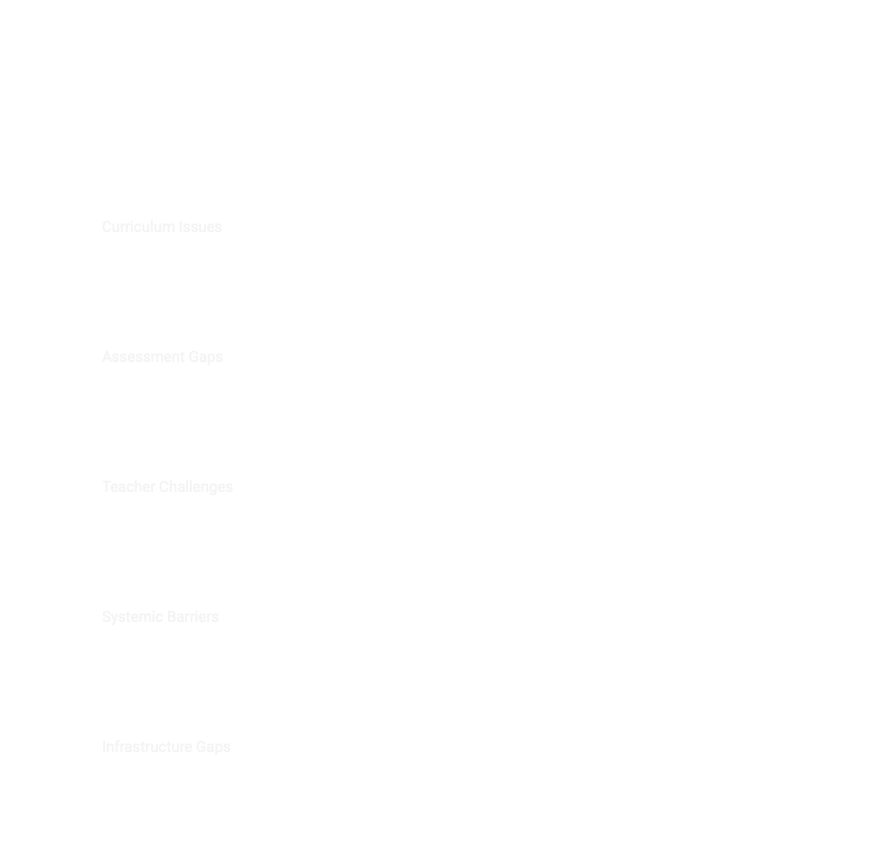
This is the central insight: once we understand all the layers of the problem, the solution becomes more obvious. The problem is not only an outdated curriculum. It is also a labor-market mismatch. It is not only a weak assessment. It is also the absence of portfolios and real-world evidence. It is not only teacher burnout. It is also weak compensation and a lack of ownership. It is not only private tutoring. It is also the political economy created by decades of underpaying teachers and forcing families into a second system. It is not only a lack of technology. It is a lack of integrated infrastructure. Online and hybrid formal education can address these layers together.
It can give students access to a broader curriculum than a single local school can offer. It can give teachers the tools to support students beyond their own subject specialty. It can give families visibility into progress and pathways. It can enable schools to launch new programs without requiring them to hire every specialist internally. It can give students access to international courses, AI literacy, career-readiness modules, English certification, university counseling, capstone projects, and global peers. It can also give teachers new earning pathways that are aligned with the formal system rather than hidden in the shadow system.
This is where the teacher-as-micro-owner model becomes essential. For more than a century, teachers have been positioned primarily as employees inside large institutional systems. They deliver curriculum, manage classrooms, follow schedules, report grades, and operate within a school's administrative structure. In that model, the teacher may be trusted by families and transformative for students, but the economic structure rarely allows the teacher to benefit directly from the value they create. The institution owns the relationship with the family. The institution owns the brand. The institution owns the infrastructure. The teacher becomes the delivery mechanism.
That structure made sense when schools were the only practical way to organize learning at scale. But it is becoming less inevitable. Across the global economy, platforms have separated professional value from fixed institutional employment. Uber did not create drivers, cars, roads, maps, payments, or customer demand. It organized them through infrastructure. Airbnb did not invent hospitality. It gave individual owners access to trust systems, payments, discovery, and demand. Shopify did not invent commerce. It allowed small merchants to operate with tools once reserved mainly for larger retailers. The same structural shift is now possible in education.
The lesson, however, should not be the casual gigification of teaching. That would be dangerous and morally wrong. Education must learn from the platform economy without repeating its worst mistakes. The teacher should not become a disposable contractor with unstable income and no protection. The teacher should become a micro-owner of educational value. That means teachers should be able to participate in revenue-sharing, profit-sharing, cohort ownership, school ownership, or teacher-led microschool models supported by robust academic and operational infrastructure.
In some cases, this could happen inside existing schools. A school might allow teachers to lead specialized academies or learning pathways, such as an AI academy, an international diploma cohort, an English certification track, a career-readiness lab, an entrepreneurship studio, an Olympic values leadership program, or a university advising pathway. The teacher could share in the revenue or profit generated by that program. The school benefits because it expands its offering without centralizing all innovation risk. The teacher benefits because excellence is rewarded with ownership, not only salary. Families benefit because the school becomes more responsive to student needs.
In other cases, teachers could create their own microschools, hybrid academies, tutoring pods, or community-based learning studios. A teacher might serve 12, 20, 40, or 60 students in a more personalized structure. But unlike informal tutoring, this model would not depend on the teacher doing everything alone. The teacher does not need to be an expert in every subject, university system, career pathway, technology tool, or assessment model. Instead, the teacher would become the trusted learning guide, coach, community builder, and parent-facing advisor, while the online school provides the wider infrastructure: accredited international courses, academic records, advising systems, AI supported personalization, learning analytics, university pathway planning, payment systems, compliance, scheduling, parent communication, and access to subject, matter experts.
This is why the Uber analogy is useful, but only if carefully understood. An Uber driver does not build the app, design the payment system, create the map, manage global customer acquisition, or negotiate every trust mechanism from scratch. The platform removes friction so the driver can focus on the essential human function: serving the passenger well. In education, a well-designed online school platform could do something similar for teachers. It could remove much of the operational burden so teachers can focus on what matters most: reaching students, building trust with families, onboarding learners, monitoring progress, motivating effort, creating community, and helping students connect learning to future opportunity.
But education must improve on the platform economy, not simply copy it. The teacher should not be a precarious gig worker. The teacher should be a respected micro-owner with real upside. That means compensation models should include revenue share, cohort ownership, profit participation, performance incentives tied to student support and retention, and pathways to launch teacher-led microschools under the academic and operational umbrella of an accredited online school. The purpose is to help great teachers earn more without destroying their health through endless private tutoring.
This model also addresses the limits of subject-based schooling. The modern student does not only need a strong mathematics teacher, literature teacher, or history teacher. Students increasingly need academic guidance, English language development, AI literacy, digital fluency, career exploration, financial literacy, global exposure, university pathway planning, character development, project-based learning, and evidence of real work through portfolios and capstones. No single teacher can provide all of that alone. But a teacher supported by an online school platform can orchestrate access to all of it.
That is the deeper opportunity. Teachers should not be limited by their own specialty, subject background, or educational bias. A mathematics teacher may become the founder of a STEM-and-university-pathway microschool. A literature teacher may lead a global humanities and writing academy. A physical education teacher may lead a student-athlete international diploma cohort. An English teacher may lead a bilingual college-readiness pathway. A school counselor may create a career and university advising studio. The teacher’s core value becomes not only what they personally know, but how well they can guide students through a wider ecosystem of learning.
This also changes the B2C model of formal education. Traditionally, families buy access to a school building, a local reputation, and a fixed academic program. In the future, families may increasingly buy access to a trusted educator supported by a global academic infrastructure. The teacher becomes the local face of trust, while the online school provides the content, credentials, data, advising, and systems. This creates a model that is more scalable than private tutoring, more personalized than traditional school, and more human than purely digital learning.
The global education market is large enough for this kind of reinvention. But the opportunity is not only financial. It is organizational. The world does not simply need more education spending. It needs a better-designed learning infrastructure that can reach students beyond the limitations of geography, school size, teacher availability, and local curriculum constraints.
This is especially important for small and mid-sized schools. Many schools know they need to offer more: AI literacy, international courses, college counseling, career pathways, English certification, entrepreneurship, capstones, global projects, and student support. But they cannot afford to build every capability internally. They may not have the staff, technology, curriculum, advising capacity, or international partnerships. Online and hybrid formal education allows schools to expand their value without pretending they can become everything on their own.
It also helps families. Parents are increasingly confused by the modern education landscape. They want strong academics, but also skills. They want university access, but also employability. They want English, but also identity. They want technology, but also values. They want personalization, but also structure. They want flexibility, but also legitimacy. A hybrid online school model can organize these needs into a coherent pathway instead of forcing families to assemble education from disconnected pieces: school, tutor, counselor, exam prep, language center, summer program, and online course.
Most importantly, it helps students. Students do not experience their lives as separate subjects, tutors, exams, or platforms. They need coherence. They need someone to help them understand who they are, what they are good at, where they are going, what they need to improve, and how today’s work connects to tomorrow’s opportunity. Hybrid formal education enables the combination of the human relationship of a trusted teacher with the systemic capacity of an online school.
This is why clear solutions emerge once all the layers are understood. If the problem were only curriculum, the answer would be better content. If the problem were only technology, the answer would be better software. If the problem were only teacher pay, the answer would be higher salaries. If the problem were only university admissions, the answer would be better counseling. But the real problem is that all these issues are connected. Therefore, the solution must also be connected.
A future-ready education model must do several things at once. It must provide accredited, high-quality online content. It must preserve local human relationships. It must support teachers with infrastructure. It must give teachers a path to higher earnings and ownership. It must reduce dependence on shadow tutoring by bringing personalized support into the formal system. It must help schools expand without excessive overhead. It must help parents understand student pathways. It must help students build portfolios, projects, skills, and credentials that matter in the real world.
This is the promise of online and hybrid formal education. Not a replacement for teachers, but a way to empower them. Not a replacement for schools, but a way to expand what schools can do. Not a replacement for community, but a way to connect the local community to global opportunity. Not a cheaper version of school, but a more flexible, integrated, and scalable architecture for learning.
The next revolution in education will therefore not come from content alone. Content is already abundant. It will not come from AI alone. AI is powerful, but it does not automatically create trust, meaning, discipline, or direction. It will come from the combination of infrastructure and human agency. The online school provides the platform. The teacher provides the relationship. The student receives a pathway. The family gains clarity. The school gains capacity. The teacher gains ownership. And formal education begins to behave less like a closed institution and more like a living ecosystem capable of reaching students wherever they are and helping them become who they are capable of becoming.
That is the real meaning of “Uber for Education.” It is not the casual gigification of teaching. It is the platform-enabled ownership of learning communities by trusted educators. It is the possibility that teachers, supported by serious infrastructure, can become micro-founders of schools, cohorts, academies, and pathways. It is the possibility that schools can become more flexible without losing legitimacy. It is the possibility that families can access more personalized formal education without depending on fragmented tutoring markets. And it is the possibility that students can finally experience education not as a sequence of disconnected requirements, but as a coherent journey toward capability, identity, and contribution.
References
Bray, M. (2009). Confronting the shadow education system: What government policies for what private tutoring?UNESCO International Institute for Educational Planning.
Economic Policy Institute. (2025). The teacher pay penalty reached a record high in 2024: Three decades of leaving public school teachers behind.
Education International. (2025). The global status of teachers 2024.
HolonIQ. (2025). The size and shape of the global education market.
McGowan, M. A., & Andrews, D. (2015). Labour market mismatch and labour productivity: Evidence from PIAAC data. OECD Publishing.
OECD. (2024). Do adults have the skills they need to thrive in a changing world? Survey of Adult Skills 2023.
OECD. (2024). PISA 2022 Results, Volume III: Creative minds, creative schools.
OECD. (2025). Education at a glance 2025: How much are teachers and school heads paid?
RAND Corporation. (2024). Findings from the 2024 State of the American Teacher Survey.
UNESCO. (2024). Global report on teachers: Addressing teacher shortages and transforming the profession.
World Economic Forum. (2025). The future of jobs report 2025.
Zhang, W. (2023). Taming the wild horse of shadow education. Routledge.
%20(1).png)