
.svg)
Agentic Education
Whether you are a parent evaluating options for your child, a teacher managing growing demands, or a school leader trying to adapt, one thing is clear: across secondary / K12 education, the landscape is evolving rapidly, expectations are rising, and families are becoming more intentional in their choices. What is less clear is whether most schools are structurally prepared to meet what students and families now need, or whether they are evolving fast enough to keep pace with the demands of this new era.
The market data makes that question more urgent, not less. As of January 2025, the international schools sector included 14,833 schools, serving more than 7.4 million students and generating $67.3 billion USD in annual fee income, according to ISC Research. ISC also reported that annual fee income was 22% higher than in January 2020. By early 2026, market reporting based on ISC data described the sector as having expanded further to roughly 15,075 schools (up about 1.6% from 2025), 7.7 million students (up about 4.1%), and $69.3 billion USD in annual fee income (up about 3.0%). This is not a niche trend. It is a large, fast-moving, increasingly competitive market (ICEF Monitor, 2026; ISC Research, 2025).
On paper, this should be a favorable environment for schools. A rising market should mean more demand, more opportunity, and more room to grow. But in practice, many school leaders are discovering that broad market growth does not automatically become growth at their own institution. Many are seeing longer decision cycles, more parent hesitation, softer retention, and increasing pressure to justify tuition in a more comparison-driven marketplace. That tension is not simply a marketing problem. It is a structural one. And increasingly, it is also a trust problem.
For years, many schools assumed that stronger branding, better advertising, or a more polished admissions narrative would be enough to drive enrollment. But the buyer has changed. Families are not only comparing schools by image, campus quality, or reputation. They are comparing them by outcomes, flexibility, academic range, university mobility, and the school’s ability to support the individual child in front of them. That shift changes everything because it moves the decision from perception to structure.
The curriculum arms race is already underway, and many schools are not losing because they lack visibility. They are losing because families can see the difference between a school that looks impressive and a school that is genuinely built for the future. ISC market reporting shows that in the last five years, the number of international schools has increased by 8%, student enrollment has increased by 10%, and global fee income has risen by more than $9 billion. At the same time, 78% of international schools now offer more than one curriculum, and 36% offer bilingual or multilingual pathways. That points to a market moving toward flexibility, hybridization, and globally portable options rather than single-track models. (ISC Research, 2024a, 2025).
That same pressure is visible in the growth of the most globally recognized academic brands. The International Baccalaureate reports that the number of IB programmes offered worldwide grew by 34.2% between 2020 and 2024. Similar number come out from several secondary key curriculum providers like Hudson Global Scholars around the world. That is a strong signal that schools are expanding internationally recognized pathways because families continue to associate those pathways with rigor, mobility, and future optionality. (International Baccalaureate, n.d.).
From the parent’s point of view, the decision is no longer just about finding a “good school.” It is about finding a school that keeps options open. Parents are asking whether the curriculum will be recognized internationally, whether English development will be truly academic and not superficial, whether AP, IB, dual diploma, or dual-credit options will be available, and whether the school can adapt if the student’s ambitions change in two or three years. In a sector that continues to expand in schools, students, and fee income, families have more options and more reasons to compare schools strategically than before. (ISC Research, 2025).
In other words, parents are not just buying education. They are buying future flexibility.
That is why curriculum has become such a decisive factor in school choice. Families increasingly see curriculum not as a static academic package, but as the infrastructure that determines what doors remain open later. A school may have a strong campus, a warm community, and excellent teachers, but if parents sense that the academic structure is too narrow, too rigid, or too locally confined, many will keep looking.
This is where school leaders feel the pressure most directly. They hear the questions during tours, family information sessions, and one-on-one admissions conversations. They know families want more optionality, more recognized credentials, stronger English pathways, better university guidance, and more personalized support. But the supply side is harder than the demand side. As of January 2024, ISC Research recorded 14,010 international schools employing 664,645 teaching staff worldwide. By 2025 and 2026, staff demand was described as above 700,000 and then roughly 730,000, underscoring the scale of the workforce challenge as the market expands. (ICEF Monitor, 2026; ISC Research, 2024b).
And the teacher pipeline is under pressure. ISC Research has described the sector as facing “unprecedented demand” for teachers and continuing recruitment strain as school growth outpaces educator supply. COBIS has similarly reported that a large majority of British international school leaders find recruiting quality teachers challenging. That means expanding pathways is not just an academic design challenge. It is a staffing, training, and operational execution challenge. (Council of British International Schools, 2022; ISC Research, 2023a, 2023b).
That is the heart of the issue: the market is moving faster than most schools can build.
Yet there is another perspective school leaders ignore at their own risk: the teacher’s perspective. Teachers are often the earliest and clearest signal of whether a school’s strategy is truly operational. They see when a school markets flexibility but the timetable remains rigid. They see when parents are promised personalized support but there is no real advising system in place. They see when advanced students are underchallenged, when struggling students are moved through the same pathway anyway, and when staff are quietly expected to become unofficial counselors, hybrid coordinators, and technical troubleshooters without added structure.
From the teacher’s point of view, the issue is rarely whether innovation is needed. Most teachers understand that families want more personalized, globally relevant pathways. The real issue is whether innovation is being implemented in a coherent, supported, and educationally credible way. Teachers do not want to become sales tools for promises the school cannot actually deliver. They want systems that help them teach better, communicate more clearly, and support students more effectively. When schools fail to build that structure, teachers feel the strain first, and families eventually feel it too.
This is why the next phase of competition will not be won by schools that simply add more programs to a brochure. It will be won by schools that reduce friction, improve clarity, and create confidence for all three core stakeholders: parents, teachers, and school leaders.
For school leaders, the question is growth and sustainability. Can the school expand its academic relevance without overextending its operations? Can it increase enrollment without eroding delivery quality? Can it justify premium tuition in a market where parents compare real pathways rather than polished messaging?
For parents, the question is trust and fit. Will this school understand my child? Will it keep future options open? Will it help us make good decisions, not just sell us a seat? If our child changes direction, accelerates in one area, struggles in another, or develops new goals, can this school adapt with us?
For teachers, the question is execution and integrity. Will the school provide the support, coordination, and communication needed to make expanded pathways work? Or will the burden of complexity fall silently onto the classroom, creating confusion, fragmentation, and burnout?
These three perspectives now intersect in one increasingly important place: the family decision journey.
This is where AI in education starts to matter, not as a novelty, but as infrastructure. The strongest case for AI in education is not replacing teachers. It is reducing friction, improving visibility, and helping families and educators make better academic decisions faster. OECD’s TALIS 2024 reporting says around one in three teachers now uses artificial intelligence in their work, while around seven in ten worry that AI can facilitate plagiarism and cheating. That combination tells us something important: adoption is real, but so is caution. The future is not “AI instead of teachers.” It is better systems around teachers. (OECD, 2025).
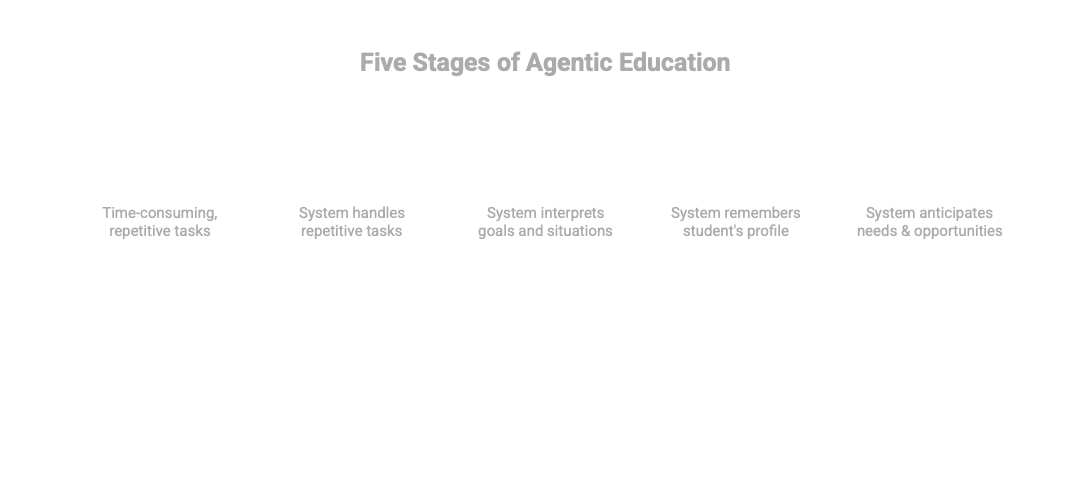
At the earliest level, these systems reduce administrative friction. From a parent’s perspective, that matters enormously. Families often form their first real impression of a school not during the campus visit, but during the admissions and onboarding process. If the journey is full of repeated forms, unclear communication, scattered documents, and confusing next steps, confidence erodes before learning even begins. A system that simplifies enrollment, gathers documents, surfaces deadlines, and keeps communication organized does not replace human interaction. It makes the institution feel more competent, more responsive, and more respectful of the family’s time.
Teachers benefit from this too. When administrative processes are better organized, less confusion spills into the classroom. Teachers spend less time clarifying logistics, chasing missing information, or compensating for communication gaps. That means more of their time can remain focused on students.
At the next level, intelligent systems improve educational search and discovery. Parents do not naturally think in course catalogs, internal school codes, or curriculum jargon. They think in lived realities. A parent might say that their child is entering 10th grade, is strong in math, may want engineering abroad, needs stronger academic English, and is considering AP or dual-credit pathways. A strong system can translate that into relevant options, support tools, readiness indicators, and possible sequences.
For parents, that creates clarity. For school leaders, it improves the visibility of specialized offerings. For teachers, it improves placement quality by helping students enter pathways that actually fit their readiness and goals rather than being selected through guesswork or incomplete understanding.
At a more advanced level, the system begins to retain memory. One of the most frustrating parts of the school journey for families is repetition. Parents often feel they must re-explain their child’s story to every new person they meet: admissions, counselor, coordinator, teacher, administrator. A system that remembers the student’s history, goals, previous coursework, assessment data, and advising context creates continuity.
That continuity matters to teachers too. A teacher who enters a conversation already understanding a student’s broader context is better positioned to support that student meaningfully. Instead of starting from zero, the relationship begins with context.
At the next level, the system becomes a planning partner. A family can ask for a two-year plan that keeps university options open, strengthens English, and stays within budget. The system can compare options, map course sequences, flag risks, and propose a structured pathway. But this is exactly where the teacher’s role becomes even more important, not less. Teachers, counselors, and academic leaders remain essential because they bring judgment, ethics, developmental understanding, and human nuance. The system organizes complexity. The educators validate, refine, and personalize the plan.
That is a crucial distinction. The future of education is not AI instead of teachers. It is better systems around teachers.
At the most advanced level, the system becomes anticipatory. It recognizes what matters next before the family asks. It can surface reminders, flag overload risks, recommend prerequisite steps, and prompt earlier intervention. For parents, this feels like real support. For students, it can prevent missed opportunities. For teachers, it can create earlier visibility into academic issues before they become crises.
This is where the next enrollment advantage will increasingly come from. Families are no longer comparing only curriculum breadth. They are comparing decision quality. They will notice which school helps them understand the path ahead with less confusion, less wasted time, and more confidence.
And yet none of this works if the internal structure is weak.
That brings us back to the most important strategic decision many schools now face: whether to continue trying to build everything internally, or to partner more intelligently in order to expand faster and more effectively.
Partnering with an international online school provider is not simply a content decision. It is an organizational decision. Done well, it allows a school to expand academic reach without having to build every capability from scratch at the same pace. In a market where most schools already operate with more than one curriculum and hybrid models are increasingly normalized, this kind of partnership is not fringe. It is increasingly part of how schools scale responsiveness without scaling every department at the same speed. (ISC Research, 2025).
From the parent’s point of view, a partnership only matters if it translates into a better student experience, clearer pathways, and stronger outcomes. Parents do not care that a school has signed a partnership agreement unless they can understand how it helps their child. They want to know what doors it opens, how it affects university admissions, how it fits into the schedule, who will guide them, and what support exists when challenges arise.
From the teacher’s point of view, a partnership succeeds only when it is well coordinated. If the online layer feels disconnected, poorly scheduled, underexplained, or operationally vague, teachers often end up managing the confusion. But if the school has clear structures, realistic expectations, and defined support roles, teachers can experience the partnership as an extension of the school’s academic capacity rather than an extra burden.
From the school leader’s point of view, the partnership becomes valuable when it solves a structural problem. It can provide immediate access to advanced courses, recognized international credentials, specialized electives, flexible pacing, and support for students whose needs do not fit the traditional timetable. It can help the school serve the high achiever who needs acceleration, the athlete managing an intense training schedule, the internationally mobile family, or the student pursuing a dual diploma pathway, all without requiring the immediate hiring of multiple specialized teachers.
But this only works if certain internal capabilities exist.
A strong university and academic counseling function is essential. Families need someone who can translate academic options into future outcomes. Without that, even strong pathways can feel abstract or confusing. Parents may hear that a school offers AP, dual-credit, or hybrid options, but if no one can explain how those choices shape university applications across different countries, the value remains underused.
A hybrid learning coordinator is equally important. Someone must own the timetable integration, communication flow, and coordination between the school, the student, the family, and the outside provider. Without this role, hybrid initiatives often drift into inconsistency. Parents become uncertain, teachers become frustrated, and the school loses the very narrative it hoped would differentiate it.
Flexible scheduling matters as well. A school cannot claim personalization while forcing every student into the same rigid timetable. If online coursework, asynchronous work, or external academic pathways are part of the offer, the schedule has to create real room for them. Otherwise, the promise remains theoretical.
Admissions training also becomes critical. Families often make decisions based on the quality of explanation as much as the quality of the program itself. If admissions teams cannot clearly explain how the expanded model works, what it offers, and why it benefits different kinds of students, the school will still lose families even if the structural pieces are technically in place.
And finally, communication with parents must become more intentional and more sophisticated. The more layered and personalized the model becomes, the more communication quality matters. Families need onboarding, progress visibility, clarity of roles, and a reliable point of contact. Strong schools understand that communication is not an accessory to the educational experience. It is part of the educational experience.
This is why the schools growing fastest are often not the ones spending the most on marketing. They are the ones building stronger systems around trust, clarity, coordination, and future relevance.
They understand that growth now depends on more than attracting attention. It depends on helping families make better decisions, helping teachers operate within better structures, and helping students move through clearer, more flexible, and more globally relevant pathways.
The real question for a school is no longer only how to increase leads. It is how to become the kind of institution that parents trust, teachers can sustain, and students can grow with.
Because when a family asks, “How far can this school take my child?” they are not only asking about curriculum. They are asking whether the school can understand the child, support the journey, adapt to change, and deliver on its promise over time.
And when teachers ask, more quietly, whether the school is truly built to support what it is now offering, they are asking a different version of the same question.
The schools that answer both well are the ones that will pull ahead.
The market is growing. Families are more informed. Teachers are more aware of what strong execution requires. The winners will not be the schools that merely look larger, louder, or more modern from the outside. They will be the ones that build the most coherent, human-centered, and operationally credible model on the inside.
That is what will drive enrollment. That is what will sustain retention. And that is what will define the next generation of school growth.
References
Council of British International Schools. (2022). Teacher supply in British international schools 2022. Council of British International Schools.
ICEF Monitor. (2026, February 25). Continuing expansion of K-12 international school sector driven more by growing local demand. ICEF Monitor.
International Baccalaureate. (n.d.). Facts and figures. International Baccalaureate Organization.
ISC Research. (2023a, March 23). Recruitment challenges hit international schools. ISC Research.
ISC Research. (2023b, November 21). Trends, challenges and strategies in international teacher recruitment and retention. ISC Research.
ISC Research. (2024a). What data tells us about the international schools market. ISC Research.
ISC Research. (2024b, February 6). Data on the international schools market in 2024. ISC Research.
ISC Research. (2025, January 24). The international schools market in 2025. ISC Research.
OECD. (2025). Results from TALIS 2024. Organisation for Economic Co-operation and Development.
%20(1).png)